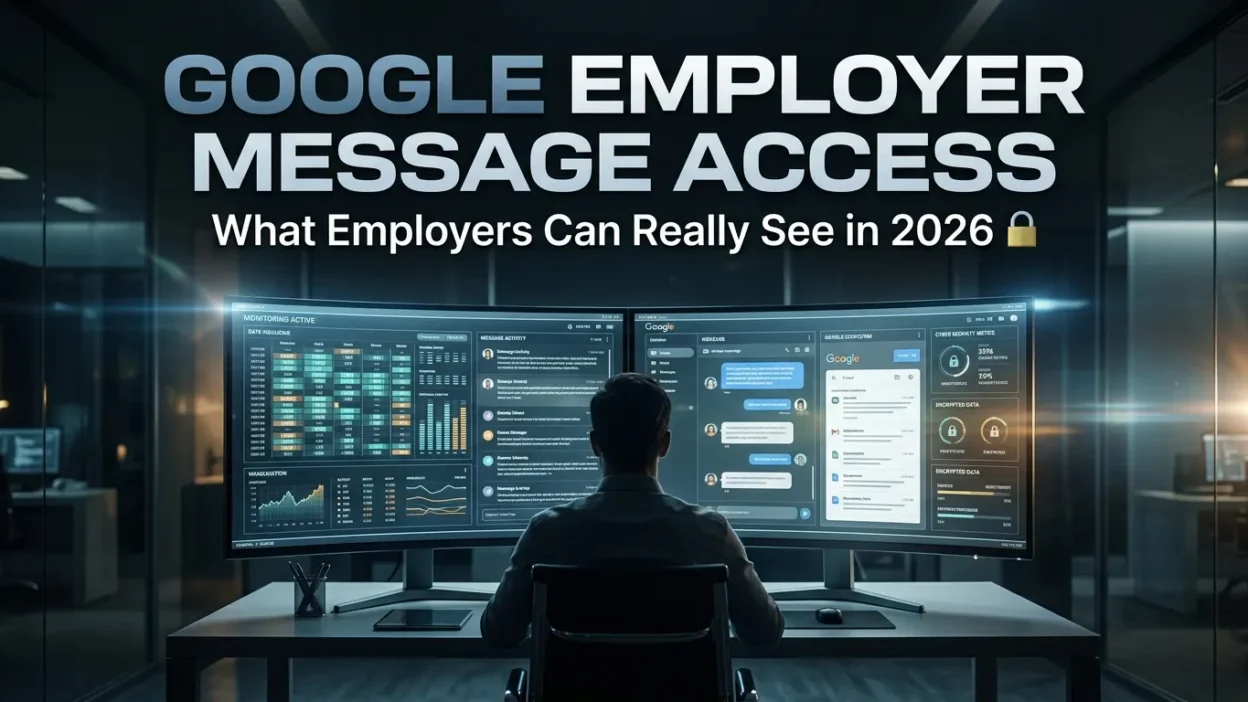
Have you ever sent a message through a Google service at work and wondered whether your employer could read it? You are not alone. Many employees have questions about workplace privacy, especially when using a company email account, work phone, or office computer.
Google employer message access depends on several factors, including the service you use, who manages your account, and whether your device belongs to your employer. Gmail, Google Chat, and Google Messages have different functions, so their privacy rules should not be treated as identical.
For example, an organization can manage its Google Workspace accounts and configure data-retention policies. Google Messages also supports message archiving on fully managed Android devices when the appropriate enterprise setup is enabled. <Cite refs={[“turn556240search3″,”turn556240search0”]} />
Understanding these differences can help you protect your personal communications without making assumptions about what your employer can see. Below, you will find useful messages to share, straightforward privacy information, and practical steps to help you understand your workplace setup.
Top Google Employer Message Access Messages
These messages are useful when you want to discuss workplace privacy with coworkers, explain account differences, or share reminders about responsible messaging.
- 🔐 Google employer message access depends on the account, service, and workplace setup.
- 💬 Before sending personal messages, check whether you are using a work account or a personal account.
- 🏢 Company-managed accounts may follow different privacy and retention policies.
- 📱 A work phone can have different management settings from your personal device.
- 🔎 Understanding your account is the first step toward understanding workplace privacy.
- 🛡️ Protect your personal information by learning which workplace policies apply to you.
- 📩 Gmail, Google Chat, and Google Messages are different services with different controls.
- ⚙️ Administrative permissions can affect how workplace data is managed.
- 🔍 Do not rely on rumors when you have a question about message privacy.
- 📖 Read your company’s technology and acceptable-use policies before making assumptions.
- 🔒 Keeping personal and professional communications separate can reduce confusion.
- 🧑💻 A company-managed Google account should not automatically be treated like a personal account.
- 📋 Ask your IT department when the rules about workplace messaging are unclear.
- 💡 Knowing who manages your account can help you make better privacy decisions.
- 🏢 Employers may have authorized ways to retain or review workplace communications.
- 📲 Personal messaging apps and workplace communication tools may have different access rules.
- 🔐 Privacy starts with understanding your account, device, and organization’s policies.
- 📰 Verify claims about workplace monitoring before sharing them with others.
- 💬 Clear workplace policies help employees understand how their information is handled.
- ✅ Make informed choices before using company technology for personal conversations.
Short Google Employer Message Access Messages
Sometimes a short statement is all you need for a quick conversation, social post, or workplace discussion. These concise messages focus on account awareness and privacy.
- 🔐 Know your account before sending.
- 💬 Work and personal accounts are different.
- 📱 Check your device’s management status.
- 🏢 Workplace policies matter.
- 🔎 Understand who manages your account.
- 🛡️ Keep personal information protected.
- 📩 Different Google services have different controls.
- ⚙️ Administrative access depends on permissions.
- 📖 Read the privacy policy.
- 🔒 Separate work from personal messaging.
- 💡 Awareness is better than assumptions.
- 📋 Ask IT when you need clarification.
- 📲 Check device policies before personal use.
- 🧑💻 Understand your workplace technology.
- 🔍 Verify privacy claims before sharing them.
- 💬 Know the rules before you message.
- 🏢 Company accounts may have retention settings.
- 🔐 Privacy requires informed choices.
- 📌 Check which account is active.
- ✅ Make privacy a daily habit.
Best Google Employer Message Access Messages for Sharing
If someone asks whether employers can read Google messages, these messages offer a simple way to explain why the answer depends on the circumstances.
- 💬 “Google employer message access is not the same for every service. Check whether you mean Gmail, Google Chat, or Google Messages.”
- 🔐 “Before assuming your messages are private, identify whether your account is managed by your employer.”
- 🏢 “A workplace Google Workspace account may be subject to organizational administration and retention policies.”
- 📱 “Using a company-owned phone can introduce additional management rules, so review the device policy.”
- 🔎 “The safest way to understand workplace message privacy is to check your account, device, and company policies.”
- 📩 “Having a Google account does not automatically mean your employer can see every personal conversation.”
- 🛡️ “Keep personal conversations separate from work systems whenever possible.”
- 📖 “If your employer’s monitoring policy is unclear, ask the appropriate IT or privacy contact.”
- ⚙️ “Administrative access depends on the service, permissions, configuration, and applicable rules.”
- 🔒 “Do not assume that deleting a workplace message removes every retained copy.”
- 💡 “Workplace privacy is easier to understand when you know which service stores the conversation.”
- 📋 “Read your organization’s acceptable-use policy before using company technology for personal communication.”
- 📲 “Google Messages and Google Chat are not interchangeable, so their access rules can differ.”
- 📰 “Check official information before believing claims about employer monitoring.”
- ✅ “Understanding workplace technology helps you make smarter decisions about personal messages.”
What Does Google Employer Message Access Mean?
The phrase generally refers to whether an employer or workplace administrator can access, manage, retain, or review messages associated with Google services used at work.
The answer depends on the specific situation. A personal Gmail account is different from a company-managed Google Workspace account. Similarly, Google Chat is a workplace collaboration service, while Google Messages handles mobile messaging such as SMS, MMS, and RCS.
Google Workspace administrators can manage organizational settings, and authorized tools such as Google Vault can retain and search supported data when the service is properly configured. <Cite refs={[“turn556240search6″,”turn556240search3”]} />
Important factors include:
- Account ownership: Is the account personal or provided by your employer?
- Service type: Are you using Gmail, Google Chat, or Google Messages?
- Device management: Is your phone or computer managed by your organization?
- Administrative permissions: Which controls and privileges have been assigned?
- Retention settings: Can workplace systems preserve messages under applicable policies?
These details matter because there is no single rule that applies to every Google service or workplace.
Can Your Employer Access Messages on a Work Google Account?
A company-managed Google Workspace account operates within an organization’s managed environment. Administrators can control certain services and data settings, while authorized users may have access to specific administrative or retention tools.
For example, Google Vault can preserve supported Gmail and Google Chat data according to configured retention rules and legal holds. The availability of these features depends on the organization’s subscription, setup, and assigned privileges. <Cite refs={[“turn556240search3″,”turn556240search7”]} />
However, this does not mean every manager or coworker can freely read every conversation. Access depends on the tools, permissions, configuration, and policies involved.
If you use a work Google account, take time to understand your employer’s privacy and acceptable-use rules. For personal conversations, using your own account on your own device is generally a clearer way to separate private communication from workplace systems.
That distinction is the best starting point for understanding Google employer message access.
Can Your Employer Access Messages on a Personal Google Account?
Using a personal Google account is different from using an account provided by your employer. However, the device you use and any workplace management software can also affect your privacy.
If you sign in to your personal Gmail account on a company computer, that does not automatically give your employer unrestricted access to your Google account. Nevertheless, the employer may have visibility into activity on its own devices or networks, depending on its monitoring tools and policies.
Consider these situations:
- Personal account on a personal device: Your employer generally does not have administrative control over your personal Google account simply because you work for the company.
- Personal account on a company computer: Workplace security tools, browser settings, or network monitoring may expose some activity.
- Personal account on a company-owned phone: Device management policies may apply, particularly if the phone is fully managed.
- Personal account inside a work profile: Android separates work and personal profiles, helping protect personal-profile data from organizational access. The exact protections depend on device ownership and management configuration. <Cite refs={[“turn144979search4″,”turn144979search7”]} />
The important point is that signing in to a personal account and using a company-managed account are not the same thing. Still, using your own device for private communications is generally the clearest way to keep personal and professional activity separate.
Can Employers Read Google Messages on a Work Phone?
Google Messages supports SMS, MMS, and RCS conversations. On certain fully managed Android devices, organizations can configure a feature that allows approved archiving applications to capture and preserve these messages.
Google’s Android Enterprise documentation explains that this feature can archive RCS as well as SMS and MMS messages when the required enterprise setup is enabled. Users are informed when message archiving is active. <Cite refs={[“turn144979search0″,”turn144979search2”]} />
However, this does not mean every employer can automatically read every Google Messages conversation on every Android phone.
Here are the main differences to understand:
- 📱 Personal Android phone: A company does not automatically gain access to all your messages just because you use Android.
- 🏢 Fully managed work phone: The organization may configure additional controls, including supported message archiving.
- 🔐 Phone with a work profile: Work and personal data are separated, although company-owned devices can have additional management restrictions.
- ⚙️ Archiving enabled: Supported messages may be captured by an approved archiving application under the configured system.
If you use Google Messages for personal conversations, check whether your phone is company-owned or managed and whether a message-archiving notice is displayed. When in doubt, ask your IT department what the device-management configuration covers.
Can Your Employer Access Gmail and Google Chat?
Gmail and Google Chat are commonly used for workplace communication, but their access and retention rules depend on how the organization manages them.
Gmail
A company-managed Gmail account may be subject to administrative policies and data-retention requirements. Organizations with the appropriate Google Workspace setup and licensing can use Google Vault to retain, search, and export supported Gmail data. <Cite refs={[“turn144979search10”]} />
This is particularly relevant when a business must preserve email records for legal, regulatory, or internal compliance reasons.
Google Chat
Google Chat can also be managed through Google Workspace. Depending on the organization’s settings, conversation history may be retained, and eligible data may be available through administrative retention and eDiscovery tools.
The presence of administrative controls does not mean every supervisor can open every employee’s conversation. Access depends on permissions, the service configuration, and applicable organizational rules.
What should employees remember?
- 📩 A work Gmail account may be subject to organizational retention policies.
- 💬 Google Chat conversations may be retained when the relevant settings and tools are configured.
- 🔎 Access to administrative tools is not necessarily granted to every manager.
- 🔐 Personal accounts and company-managed accounts have different privacy considerations.
- 📋 Your organization’s policies can explain what data may be monitored or retained.
For workplace communication, assume that information sent through company-managed systems may be retained according to the organization’s policies. Avoid using work services for sensitive personal conversations.
How to Check Whether Your Google Account Is Managed
If you are unsure whether your Google account is managed by an employer, you can take a few practical steps.
- Check the email address: A company-provided address using your organization’s domain is often a sign of a managed work account, although the address alone does not establish every access permission.
- Review account settings: Look for notices indicating that your account is managed by an organization.
- Check your device settings: On Android, review whether a work profile or device-management application is present.
- Read workplace policies: Search your employee handbook or technology policy for terms such as monitoring, retention, mobile device management, and acceptable use.
- Ask IT directly: Request clarification about which services are managed, what data is retained, and who is authorized to access it.
If you use a personal Google account, you can also review its security settings and signed-in devices. These checks help you understand your own account, although they cannot reveal every monitoring tool that might be installed on a company-owned device.
Best Messages for Captions
These short captions can help you share general reminders about workplace messaging and digital privacy.
- 🔐 Privacy begins with awareness.
- 💬 Know where your messages belong.
- 📱 Keep work and personal life separate.
- 🛡️ Protect your digital space.
- 🔎 Understand your account settings.
- 🏢 Workplace policies deserve attention.
- 📩 Think before sending sensitive information.
- ⚙️ Check the settings before making assumptions.
- 🔒 Better privacy starts with better habits.
- 💡 Knowledge makes digital decisions easier.
Copy-Paste Ready Messages About Google Employer Message Access 🔐
Use these short messages when you need to ask about workplace privacy or clarify your company’s messaging policy.
- 💬 “Could you please clarify the company’s policy on employee message privacy?”
- 🔐 “I’d like to understand which messages may be monitored on company-managed devices.”
- 📱 “Does the company have access to messages on personal phones connected to work accounts?”
- 📧 “Can you confirm whether company Gmail accounts are subject to email retention or review?”
- 🛡️ “I want to make sure I understand the difference between personal and work account privacy.”
- 💻 “Are Google Chat conversations retained for compliance or business purposes?”
- 📋 “Could you share the company’s device monitoring and data retention policy?”
- 🔎 “How can I check whether my Google account is managed by my organization?”
- 🤝 “I’d appreciate clarification about which data administrators can access.”
- 📲 “Does the company manage the entire phone or only its work profile?”
- 📝 “Please let me know whether employees are notified when message archiving is enabled.”
- 🔍 “I would like to understand how company messaging data is stored and reviewed.”
How to Protect Your Privacy at Work 🛡️
If you are concerned about Google employer message access, take a few sensible steps before assuming your conversations are private or monitored.
- Use separate accounts: Keep personal conversations in your personal Google account and use your work account for business.
- Check device ownership: A company-owned phone may be managed differently from your personal phone.
- Review account management: Check whether your Google account says it is managed by your organization.
- Read company policies: Look for rules covering monitoring, retention, acceptable use, and investigations.
- Ask IT or HR: If the policy is unclear, request a written explanation of what the company can access.
- Avoid sensitive personal conversations on work systems: Use personal services on a personal device when appropriate and permitted.
- Do not try to bypass company controls: If you need privacy, clarify the policy and use an appropriate personal device and account instead.
Google Workspace organizations may use Google Vault to retain, search, and export eligible Gmail and Google Chat data. Access depends on licensing, configuration, permissions, and the type of data involved. For example, Google says Chat messages sent with history off are not searchable through Vault in the same way as messages sent with history on. <Cite refs={[“turn955686search1″,”turn955686search2”]} />
Frequently Asked Questions❓
1. Can my employer read my personal Gmail?
Generally, an employer does not automatically gain access to a separate personal Gmail account simply because you work for the company. However, access may be possible in other circumstances, such as when you use a company-managed device, share account access, or have connected your account to workplace systems. Check the actual device and account policies rather than assuming every situation is the same.
2. Can my employer read Google Chat messages?
If you use Google Chat through a company-managed Google Workspace account, authorized administrators or legal personnel may be able to retain and search eligible conversations under the organization’s configuration and permissions. Google Vault supports searches of certain Chat messages, particularly those sent with conversation history enabled. <Cite refs={[“turn955686search1″,”turn955686search2”]} />
3. Can my employer access Google Messages on my work phone?
Potentially, depending on device management and the tools configured by your employer. Google documents RCS message archiving for certain fully managed Android devices when an organization configures an approved archiving solution. This does not mean every employer automatically sees every Google Messages conversation. <Cite refs={[“turn144979search0″,”turn144979search2”]} />
4. How can I tell whether my Google account is managed by my employer?
Open your Google Account settings and look for a notice that the account is managed by your organization. You can also ask your IT department to confirm whether the account belongs to a Google Workspace organization. Remember that account management and access to message content are different things.
5. Does deleting a message guarantee that my employer cannot access it?
No. Deleting a message from your visible mailbox or chat history does not necessarily remove copies that are retained under an organization’s applicable retention rules or legal holds. Google Vault can preserve certain eligible data even after users delete it. <Cite refs={[“turn955686search0″,”turn955686search1”]} />
Conclusion 🔐
Understanding Google employer message access starts with knowing which account you use, who owns your device, and how your organization manages its communication tools. A company-managed Google Workspace account may be subject to administrative controls, retention policies, and authorized investigations. Personal accounts and personal devices can have different privacy protections, although the exact situation depends on how they are configured and connected to workplace systems.
The most important point is that employer access is not identical across Gmail, Google Chat, Google Messages, and Android devices. Rather than relying on assumptions, check your account’s management status, review workplace policies, and ask your IT department for clarification when necessary. If a conversation is personal or sensitive, avoid using company systems unless you understand the relevant privacy rules.
A little awareness can help you make better decisions, protect personal information, and use workplace technology responsibly.

Noah Anderson is a content writer at MessagesfyHub, specializing in heartfelt messages, wishes, quotes, and greetings for every occasion. He is passionate about creating meaningful, easy-to-share content that helps people express their emotions with the right words.